
Parenting the Heart
Aug 5, 2026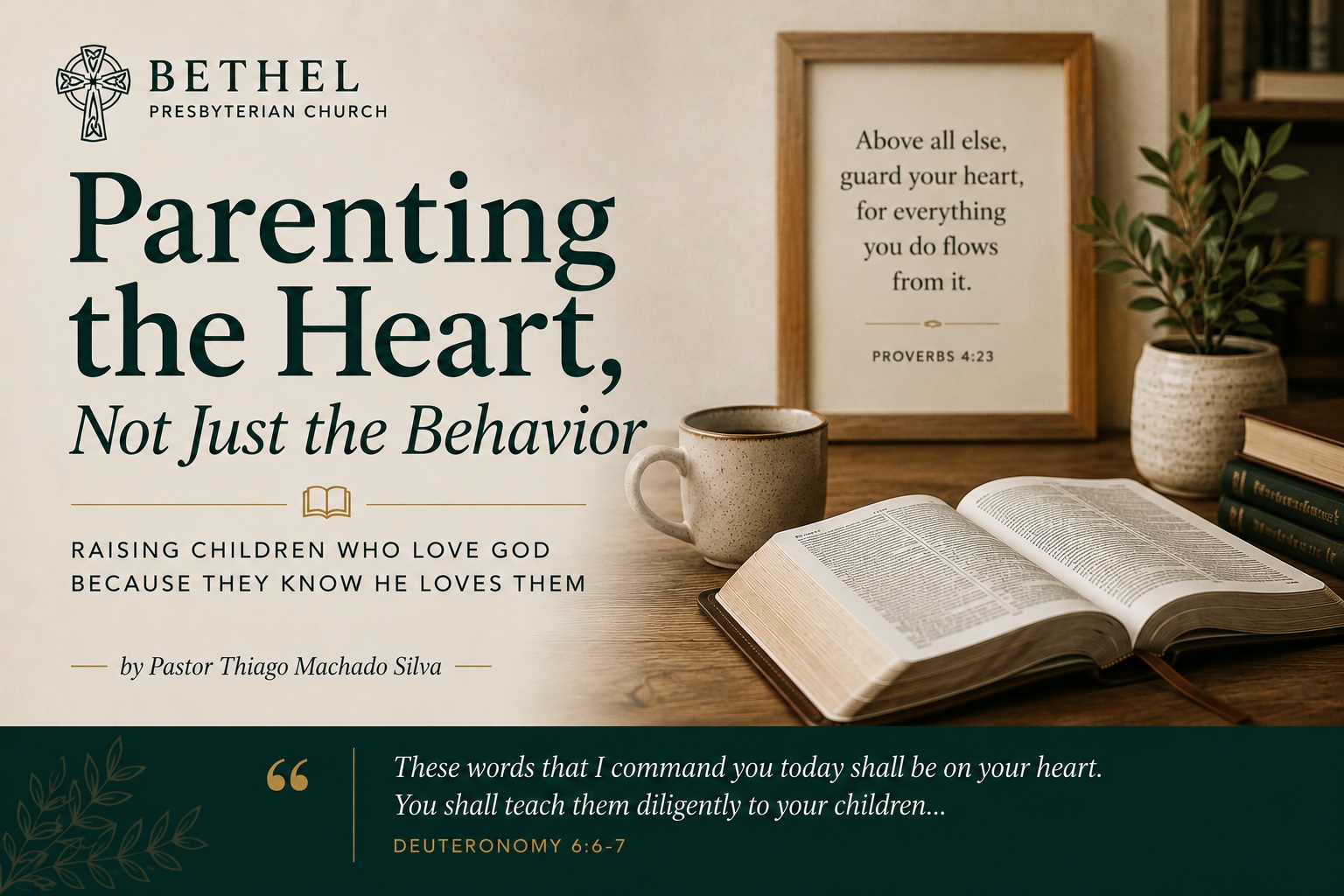
You can get a child to stop hitting his brother by taking away his tablet. You can get a child to say sorry by standing over her until the words come out. You can get a teenager to come home by curfew through threats alone. None of that is wrong exactly. But none of it touches what the Bible actually cares about most, which is the heart behind the behavior.
Scripture is far more interested in the heart than in the outward act. Jesus said it plainly in Luke 6:45, out of the abundance of the heart the mouth speaks. In Mark 7, he traced sinful behavior back to what comes from within a person, not what comes at them from outside. If that is true of adults, it is true of our children too. A child who stops hitting his brother because he is afraid of punishment has learned some self control, and that is not nothing. But he has not necessarily learned why hitting is wrong or what should replace the anger underneath it.
This is the difference between behavior modification and heart oriented parenting. One manages the outside. The other addresses the inside, trusting that changed hearts eventually produce changed behavior that actually lasts.
Proverbs Is About Wisdom, Not Just Rules
It is easy to read Proverbs as a list of moral commands, do this, do not do that. But Proverbs is really a book about wisdom, about learning to see the world the way God sees it and to love what God loves. Proverbs 4:23 tells us to guard our hearts above everything else we guard, because all of life flows from there. The goal of raising wise children is not a list of behaviors checked off. It is a heart increasingly shaped by the fear of the Lord, which Proverbs calls the beginning of wisdom.
This means that when your child disobeys, the most important question is rarely just what did you do. It is what did you want badly enough that you were willing to disobey to get it. That question gets underneath the behavior to the actual battle going on inside your child, a battle every one of us still fights as adults.
Every Sin Is Rooted in a Misplaced Love
Underneath most childhood disobedience is something a child wanted more than obedience in that moment. Attention. Control. Comfort. Being first. Avoiding pain or embarrassment. These are not exotic sins invented by children. They are the same idols that tempt adults, just smaller and less disguised.
When you catch your child lying, the surface problem is the lie. The deeper problem is usually fear, of punishment, of disappointing you, of looking bad. When a child melts down over a toy, the surface problem is the outburst. The deeper problem is a heart that has, for a moment, decided that toy matters more than kindness or obedience. Naming that underlying want out loud, gently and without shaming your child, does something a chart or a sticker never will. It helps your child see themselves accurately, which is the first real step toward repentance rather than mere compliance.
Questions That Get Past the Surface
Try asking a few simple questions instead of only asking what happened. What were you hoping would happen? What did you believe in that moment that was not true? What would it have looked like to love your brother or sister right then instead of yourself? These questions take longer than a quick correction. They also do far more lasting work, because they train your child to examine their own heart rather than simply learning how to avoid getting caught next time.
None of this means discipline disappears. Consequences still matter, and Scripture is clear that discipline itself, done rightly, is an act of love rather than something opposed to it. Proverbs and Hebrews both make that connection directly. But consequences paired with honest conversation about the heart accomplish something consequences alone cannot.
Grace Driven Correction, Not Fear Driven Compliance
Here is where the gospel changes everything about how we discipline. If our only goal is well behaved kids, fear works fine in the short term. Threats produce compliance. But fear driven obedience tends to break down in the teenage years, once the threats no longer carry the same weight, or it produces adults who obey out of anxiety rather than love, always waiting for the other shoe to drop.
Grace driven correction looks different. It sounds something like this. What you did was wrong, and there will be a consequence, and none of that changes how much you are loved. This mirrors how God deals with us. He disciplines those he loves, not to punish us into acceptance, but because we are already accepted in Christ. Hebrews 12 draws that connection directly. Our children need to feel that same order in our homes, correction that flows out of love already secured, not love that has to be earned back through good behavior.
The Danger on Both Sides
Two extremes are worth naming. One is permissiveness, avoiding correction because we are afraid of conflict, or because we have confused grace with the absence of consequences. That is not love. Proverbs is blunt that failing to discipline a child is a failure to love them well.
The other extreme is legalism, correcting behavior so relentlessly that a child never hears the gospel underneath the rules, only performance and disappointment. That tends to produce either rebellion or a brittle, fearful kind of obedience that eventually cracks. The biblical path runs between both, correction that is serious about sin and just as serious about grace.
A Long, Slow Work
Heart level parenting is slower than behavior charts and star stickers. It requires a patience most of us do not have naturally, especially after a long day. But it is the kind of parenting that actually matches how God has always dealt with his people, patiently, over a lifetime, working from the inside out. You will not finish this work in a season, or even in eighteen years. You are planting seeds whose fruit you may not see for a long time. Trust the process to the God who began it, and keep aiming, patiently, at your child's heart, not just their hands.
Pastor Thiago Silva